Types Of Wood Fence Panels . Web the range in cost for panels is roughly around $40 to $300 for 6 to 8 ft length. Web pinewood and cedar wood are two of the most popular wood types for making durable fence panels. What Types of Wood are Used for Norfolk Wood Fences? Hercules Fence from www.fencesvirginiabeach.com They make for great garden dividers, screens or even garden features. Web hit and miss fence panels are also pressure treated, giving you a longer guarantee even though it is still timber. Web types of wood fence panels.
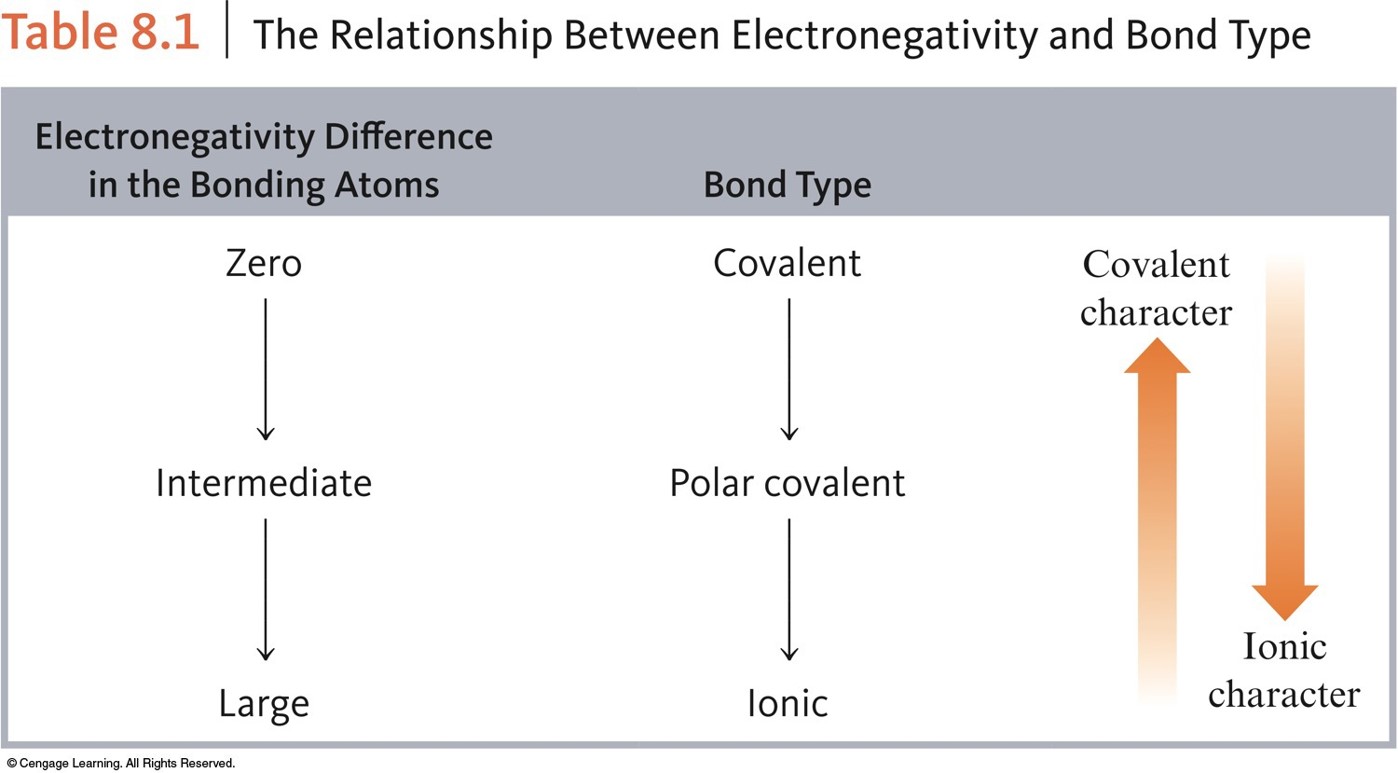
Electronegativity And Bond Type. The third and fourth columns of the table give the sum and difference of the electronegativity for the elements in the compounds. When it is large, the bond is polar covalent or ionic.
Chapter 7 Presentation from shaunmwilliams.com
Calculate the difference between the electronegativities of the atoms across each bond by subtracting the lower. 9* type of bond type of sharing nonpolar polar ionic equal unequal none, transfer *there must be a metal to be considered ionic c. The differences in electronegativity (δen) affect the type of bond.
In Fact, The Electronegativity Difference Provides Another Way Of Predicting The Kind Of Bond That Will Form Between Two Elements, As.
This type of bond occurs when there is complete transfer (between the two atoms) of the electrons in the bond. Predicting bond type w gordon sproul department of chemistry, university of south carolina at beaufort, beaufort, sc 29902; Science and education electronegativity and bond type:
Electronegativity Has A Strong Link To The Type Of Bond Two Elements Form.
Bond scale varies slightly from textbook to textbook but the pauling scale is the most commonly used. The differences in electronegativity (δen) affect the type of bond. Substances such as nacl and mgcl 2 are the usual examples.
Electronegativity Can Tell Us A Lot About How Different Elements Will Bond To Each Other And Which Type Of Bond It Will Be.
So if the difference in electronegativity is greater than 0.5, you can go ahead and consider it to be mostly a polar covalent bond. This last example is about as polar as a bond can get. Using differences in electronegativity to classify bonds as covalent, polar covalent, or ionic.
Use The Following Table To Look Up The.
This page explains what electronegativity is, and how and why it varies around the periodic table. In general, large differences in electronegativity result in ionic bonds, while smaller differences result in covalent bonds. Gdsproul@gwm.sc.edu electronegativity, en, and electronegativity difference, ∆en, are used to explain many chemical observations such as acidity of solvents, mechanisms of chemical reaction,
If The Difference Is Between 0.4 And 1.7 Then The Bond Is Considered Polar Covalent.
The types of bonding (metallic bond/covalent bond/ionic bond) are localized around the three corners of the triangle, with the transitional types between them. Among the various attributes of chemical compounds, bond type is perhaps the most characteristic. Electronegativity differences in bonding using pauling scale.


Comments
Post a Comment